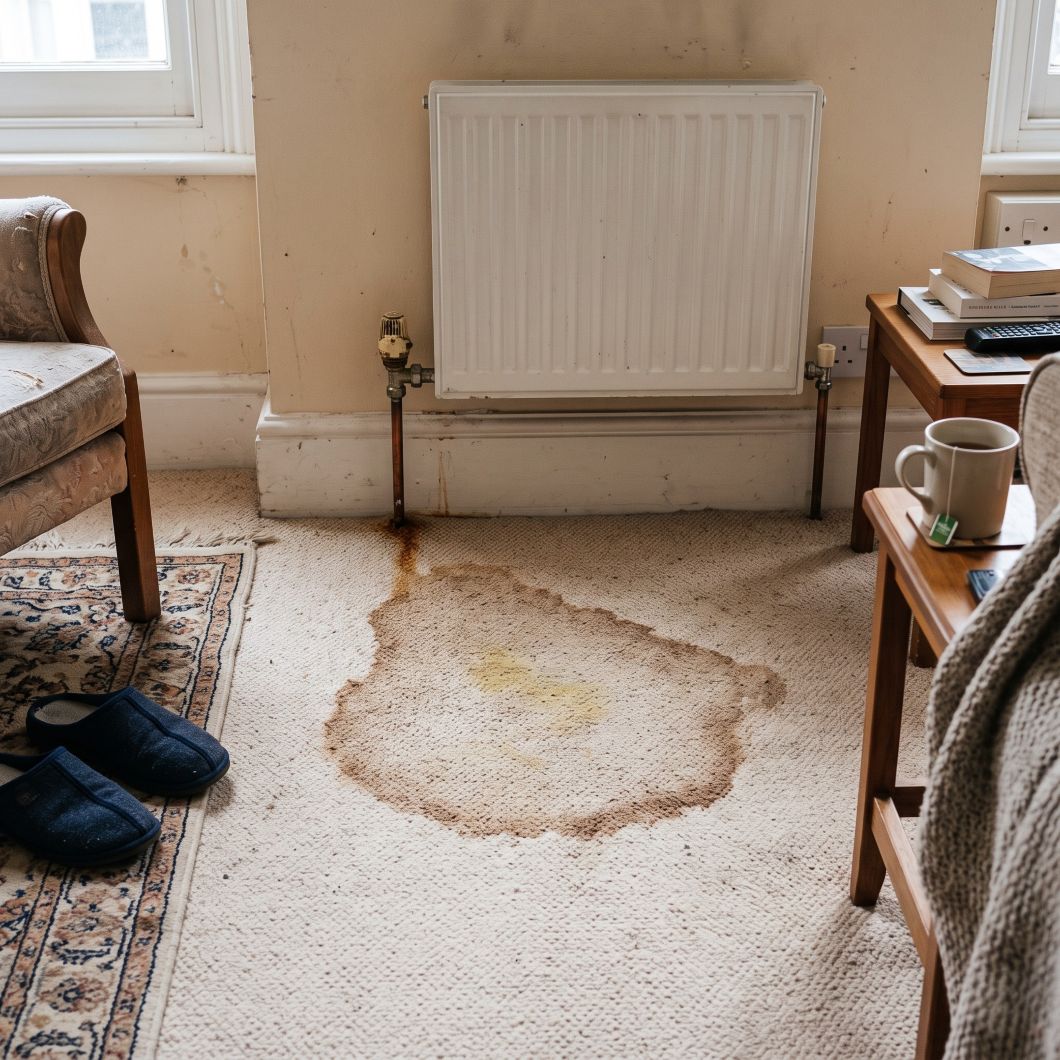
A radiator leak rarely announces itself. You notice it only when a spreading brown patch appears on the carpet beneath, often hours or days after the water first escaped. That orange-brown mark is rust, and it behaves very differently from a spill of tea or mud. The water seeping from a corroding radiator or its pipework carries dissolved iron, and as that iron meets the air it oxidises and bonds to the carpet fibres as iron oxide. This is a chemical deposit, not ordinary surface dirt, which is exactly why a squirt of supermarket carpet cleaner does nothing to it and why a hurried, heavy-handed attempt can set the stain for good. Restoring the carpet successfully depends on understanding what you are actually dealing with and acting in the right order.
What causes the rusty brown stain after a radiator leak?
The culprit is the system itself rather than the carpet. Central-heating water sits inside steel radiators and iron or steel pipework for years, and over time the metal corrodes from the inside. The water in the system becomes laden with iron and a black sludge of iron oxide known as magnetite. When a seam, valve, or joint finally weeps, that iron-rich water escapes onto the floor. On contact with oxygen in the air, the dissolved iron oxidises further and forms the familiar reddish-brown iron oxide we call rust. The longer the water sits and dries, the more thoroughly that oxidation completes, which is why a leak left undiscovered overnight almost always leaves a darker, more entrenched mark than one caught while still wet.
Why rust is a chemical deposit, not surface dirt
The crucial point is what happens next. Most stains are particles or oils resting among the fibres, which is why they respond to detergent and agitation. Rust instead forms an ionic bond with the fibre surface, effectively becoming chemically attached to it rather than simply sitting on top. The colour you see is iron locked onto the carpet at a molecular level. This is also why the stain often looks worse at the edges, where the water wicked outwards and dried slowly, leaving a darker tide line. Because the iron has bonded rather than settled, no amount of ordinary lifting or blotting will shift the colour once it has set. The bond has to be chemically broken before the iron can be rinsed away, and that single fact governs every sensible step that follows.
Why does ordinary carpet cleaner fail on rust?
Standard carpet shampoos and spot cleaners are built to tackle the soiling a home normally produces, namely grease, food, mud, and general grime. They work by surrounding oily and particulate soil so it can be suspended in water and rinsed out. That mechanism is useless against rust because there is nothing loose to surround. The iron oxide is bonded to the fibre, so a surfactant simply washes over the top of it and leaves the colour exactly where it was.
The role of acids in breaking the bond
Rust responds to chemistry of a different kind. Acids dissolve iron oxide by converting it into a soluble iron compound that can then be flushed out of the fibre with water. This is why effective rust treatments are acidic rather than detergent-based, drawing on agents ranging from mild household acids such as acetic and citric acid through to oxalic acid, the active ingredient in most dedicated rust removers. The acid breaks the bond; the rinse carries the freed iron away. Get either half wrong and the stain stays. It is also why reaching for a stronger general-purpose cleaner achieves nothing useful. The problem was never that your cleaner was too weak. It is that you were using the wrong kind of product entirely, and recognising that early saves a great deal of fruitless scrubbing that can damage the pile.
What should you do in the first hours after discovering the leak?
Speed matters, but so does restraint. The first job is not the stain at all but the source. Stop the leak by closing the radiator valves, and if you cannot isolate it, turn off the heating system and call a plumber. Until the water stops arriving, anything you do to the carpet is undone the moment fresh iron-rich water seeps back through. Once the flow has stopped, lift as much moisture as you can. The aim at this stage is purely to remove the iron-rich water before more of it oxidises in place, not to treat the colour itself, which comes later and only once the area is as dry as you can make it.
Why blotting and cool air matter
Blotting, not rubbing, is the rule. Press a clean white cloth or a thick wad of kitchen paper firmly onto the wet area to draw the water upward, and keep replacing it as it darkens. Rubbing does the opposite of what you want, grinding the iron deeper into the pile and spreading the stain across a wider area. Work from the outer edge of the patch inwards so you do not enlarge it. Heat is the other thing to avoid completely. Do not aim a hairdryer or a fan heater at the stain and do not place it near a working radiator, because heat accelerates oxidation and helps set the iron permanently into the fibre. Cool air movement and an open window are far safer for drying, and patience here pays off more than speed. Lift the carpet at the edge if you can to check the underlay and the floor beneath, because trapped damp left under a London flat’s carpet for days invites both a lingering odour and the beginnings of mould, particularly in poorly ventilated period conversions where airflow under the floor is limited.
Which home treatments help, and which make it worse?
If the stain is small and fresh, some kitchen-cupboard remedies are worth trying before calling anyone, provided you test them first. White vinegar is the gentlest starting point, dabbed on, left for a few minutes to let the acid work, then blotted and rinsed with a little cool water. Lemon juice does much the same job, and a paste of lemon juice with cream of tartar can be left briefly on a stubborn mark before being blotted away. Always patch-test on a hidden corner first, since some carpet dyes are themselves acid-sensitive.
The bleach mistake and the wool problem
The treatments that make things worse are worth knowing in detail, because they are the instinctive ones. Never reach for chlorine bleach. It does not dissolve rust the way an acid does; instead it can oxidise the iron further, sometimes setting the stain darker, and it readily strips the carpet’s own colour and weakens the fibres. Mixing household chemicals in the hope that something works is equally unwise and can release harmful fumes. Wool deserves special caution. A great many older London homes are carpeted in wool for its quality and warmth, and wool is easily damaged by harsh alkalis, chlorine bleach, and aggressive scrubbing, all of which can felt or discolour the pile irreversibly. If you are in any doubt about the fibre, the safest home treatment is the mildest one, applied sparingly, or none at all while you wait for a professional assessment.
When does a rust stain need professional restoration?
Plenty of rust stains are beyond a sensible home fix, and recognising the limit protects the carpet. A large stain, an old one that has fully set, a mark on a delicate or wool carpet, or any case where the iron-rich water has soaked through to the underlay all call for professional restoration. So does any sign that the leak has caused damp in the floor structure beneath, which is common in the ageing pipework of converted Victorian and Edwardian houses across the capital.
Why professional rust treatment is about control, not strength
Professional rust removal is not simply a matter of stronger chemicals. It is a matter of control. A specialist will identify the fibre type, select an appropriately acidic rust remover, frequently oxalic-acid based, and apply it at a measured concentration for a controlled time before neutralising it and rinsing thoroughly with hot-water extraction. That final, complete rinse is what ordinary cleaning cannot replicate, because any acid residue left behind will itself damage the carpet over time. The aim is to break the iron bond and flush every trace of both the rust and the treatment away without harming the dye or the fibre. Some heavy-duty industrial rust products contain far more hazardous acids and are emphatically not suited to domestic use, which is another reason the work is best left to someone equipped to handle and neutralise them safely.
How do you stop radiator leaks from staining carpet again?
Prevention is mostly about the heating system rather than the carpet. London’s housing stock leans heavily on older central-heating systems, and the city’s hard water encourages the internal corrosion and sludge build-up that lead to leaks in the first place. Keeping a corrosion inhibitor topped up in the system, having it power-flushed when sludge accumulates, and booking regular boiler and radiator servicing all reduce the chance of a weep developing. These measures tackle the corrosion at its root, slowing the internal decay that eventually produces both the sludge and the leak.
Maintenance and early detection
Early detection does the rest. Check the valves and joints of older radiators periodically for damp patches, telltale flaking paint, or a faint rusty bloom, since these often appear well before a visible leak. A drip tray or a moisture sensor beneath a radiator known to be ageing buys you warning time, and addressing a minor weep promptly is far cheaper than restoring a stained carpet and a damp floor later.
A rusty brown stain is daunting because it looks permanent, and left untreated or treated wrongly it genuinely can be. Approached correctly, though, it is simply iron that has bonded to fibre and needs the right chemistry, applied with patience and rinsed away completely, to release its grip on the carpet.